
There is a common misconception that Accounting and Finance know everything.
Somehow, we’re assumed to have a crystal ball that tells us where the company has been, where it is today, and exactly where it is going next.
And not only are we expected to know—but we are expected to know the right answers to everything.
The expectation often looks like this:
- Perfect forecasts
- Perfect answers
- Perfect spreadsheets
The reality? There is no perfect anything. Complexity moves faster than certainty.
Markets shift. Regulations evolve. Customer behavior changes. What seemed true six months ago may have changed three times since then.
Because of this, the best Accounting and Finance leaders aren’t the ones with all the answers.
They’re the ones asking the best questions.
🚫 From “Department of No” to Strategic Partner
Historically, Accounting and Finance have been described in many ways:
Scorekeeper.
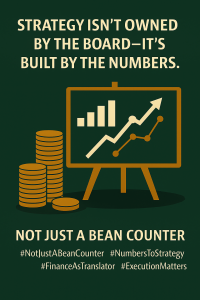
Bean Counter.
Compliance Cop.
Budget Police.
The “No Team.”
The expectation from leadership has often been simple: deliver definitive answers, protect the numbers, and control risk.
While we Accounting and Finance professionals may laugh about some of those affectionate labels, the model itself doesn’t work well in modern business.

The speed of business today is simply too fast.
Data changes constantly. Competitive dynamics shift overnight. Entire industries can pivot in a matter of months.
Yet many organizations still operate under an outdated assumption that Accounting and Finance should stay in their lane, sit quietly in the back office, and count the beans.
But modern business doesn’t operate in silos.
Strategy requires cross-functional insight. Sales, Operations, Marketing, Product, and Accounting and Finance all contribute perspectives that shape better decisions.
As a result, Accounting and Finance leadership is evolving—from answer provider to strategic questioner.
❓ Better Questions > Better Answers
Let’s be honest.
Most of us ended up in Accounting and Finance because we have a slightly unusual relationship with numbers.
Some of us see numbers everywhere. Even while walking through the grocery store, we’re calculating which jar of pickles provides the best price per ounce relative to the available storage space in our refrigerator.
But that analytical mindset also allows Accounting and Finance professionals to approach problems differently.
Instead of jumping straight to answers, we often start with questions.
Some of the most powerful questions I’ve heard from Accounting and Finance leaders include:
- What assumptions are driving this forecast?
- What would have to be true for this strategy to work?
- What risks are we not discussing?
- What does the data not explain yet?
- What decision are we really trying to make?

Notice something interesting.
Numbers and data are only mentioned twice in that list.
The real value of Accounting and Finance leadership isn’t just calculating results.
It’s framing the questions that move the conversation forward.
Good questions create clarity.
Good questions align teams.
Good questions uncover risks that might otherwise go unnoticed.
In other words, Accounting and Finance leaders unlock value not just by presenting numbers—but by guiding thinking.
🐧 Not-Just-A-Bean-Counter Takeaway 😉
In a world where business conditions change constantly, having perfect answers is unrealistic.
But asking the right questions?
That’s where leadership begins.
The shift for Accounting and Finance isn’t about abandoning analysis. It’s about recognizing that analysis alone isn’t leadership.
Leadership starts when Accounting and Finance help the organization think more clearly about the decisions ahead.
And that begins with better questions.
Ready to join a community where we laugh, learn, and occasionally cry over Excel errors?
👉 Read more or follow us on LinkedIn.
Don’t forget to check out my book on Amazon!